What is Methylene Blue?
Methylene blue is a synthetic compound with over 150 years of medical history. First synthesized in 1876 as a textile dye, it became the first synthetic drug used in humans and remains one of the most studied small molecules in biochemistry. Today, it is valued by biohackers and longevity researchers for its unique ability to support mitochondrial function and cognitive performance.
Quick Facts
- Chemical Name
- Methylthioninium chloride
- Molecular Formula
- C16H18ClN3S
- CAS Number
- 61-73-4
- Molecular Weight
- 319.85 g/mol
- First Synthesized
- 1876 by Heinrich Caro (BASF)
- FDA Status
- Approved antidote for methemoglobinemia
- WHO Essential Medicine
- Yes (since 1977)
- Oral Bioavailability
- ~72%
A 150-Year History
Methylene blue was first synthesized in 1876 by German chemist Heinrich Caro at BASF (Badische Anilin- und Soda-Fabrik) in Ludwigshafen, Germany. Originally developed as a textile dye for cotton, its medical potential was discovered when researchers noticed its affinity for certain tissues.
In 1891, Paul Ehrlich used methylene blue to treat malaria patients in Berlin — making it the first synthetic drug ever administered to humans. Ehrlich recognized that the dye selectively stained certain cells, pioneering the concept of "magic bullets" in medicine. His work with methylene blue contributed to his 1908 Nobel Prize in Physiology or Medicine.
Throughout the 20th century, methylene blue found applications in surgical staining, urinary tract antisepsis, and diagnostic procedures. In 1984, the FDA approved it as an antidote for methemoglobinemia — a condition where hemoglobin cannot carry oxygen effectively. Today, methylene blue is on the WHO Essential Medicines List and has over 170 registered clinical trials on ClinicalTrials.gov.
Modern interest in methylene blue for cognitive and longevity applications emerged from research by Dr. Francisco Gonzalez-Lima at the University of Texas at Austin, who demonstrated its unique mechanism as a mitochondrial electron carrier in the early 2000s.[4]
How Methylene Blue Works
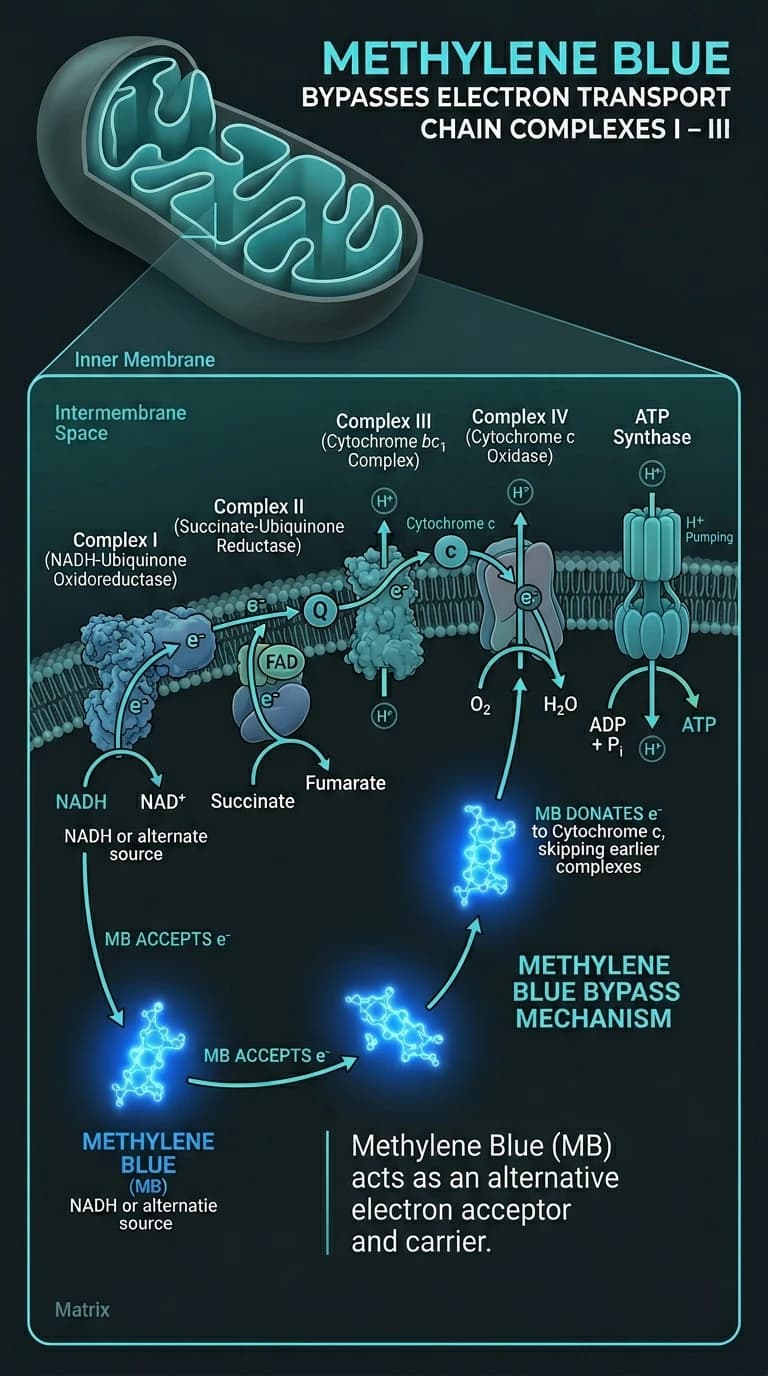
Methylene blue is unique among supplements because it acts directly within the mitochondrial electron transport chain (ETC) — the cellular machinery that produces ATP (adenosine triphosphate), your body's primary energy currency.
The Electron Carrier Mechanism
The ETC consists of four protein complexes (Complex I-IV) that pass electrons through a series of redox reactions, ultimately generating ATP. When complexes become damaged by aging, oxidative stress, or toxins, electron flow is disrupted and energy production suffers.[2]
Methylene blue acts as an alternative electron carrier. In its oxidized form, it accepts electrons from NADH; in its reduced form (leucomethylene blue), it donates electrons directly to cytochrome c. This creates a bypass pathway around damaged Complex I and Complex III, maintaining ATP production even when primary ETC complexes are impaired.[3]
Crossing the Blood-Brain Barrier
Due to its small molecular weight (319.85 g/mol) and lipophilic properties, methylene blue readily crosses the blood-brain barrier. It preferentially accumulates in mitochondria-dense neural tissue — which is why cognitive and neuroprotective effects are among its most documented benefits.[3]
Reducing Oxidative Stress
Beyond energy production, methylene blue reduces the formation of reactive oxygen species (ROS). When the ETC is impaired, electrons can "leak" and react with oxygen to form damaging free radicals. By providing an alternative pathway for electrons, methylene blue reduces this leakage — a dual benefit of more energy and less oxidative damage.[3]
Research-Backed Benefits
Methylene blue has over 150 peer-reviewed studies supporting its role in cognitive function, neuroprotection, and mitochondrial support. Below is selected evidence from controlled human trials.
Cognitive Enhancement
Rodriguez et al. (2016) demonstrated 7% improvement in memory retrieval and increased fMRI activity in attention/memory regions in a double-blind RCT.[1]
Mitochondrial Support
Acts as alternative electron carrier, maintaining ATP production when ETC complexes are impaired. Reduces ROS leakage and oxidative stress.[2]
Neuroprotection
Talley Watts et al. (2014) showed reduced lesion volume and improved behavioral outcomes following mild traumatic brain injury.[5]
Memory Consolidation
Gonzalez-Lima & Auchter (2015) demonstrated enhanced fear extinction retention via cytochrome oxidase upregulation in memory circuits.[4]
| Study | Year | Design | N | Finding | p-Value |
|---|---|---|---|---|---|
| Rodriguez et al. | 2016 | RCT (double-blind) | 26 | 7% improvement in memory retrieval; increased fMRI activity in attention and memory regions | p < 0.05 |
| Wen et al. | 2011 | In vivo / in vitro | preclinical | Rescued mitochondrial Complex I inhibition; maintained ATP production via alternative electron transfer | p < 0.01 |
| Tucker et al. | 2018 | Systematic review | multi-study | Comprehensive evidence for neuroprotection via mitochondrial enhancement, ROS reduction, autophagy modulation | -- |
| Gonzalez-Lima & Auchter | 2015 | Controlled trial | 42 | Improved fear extinction retention via cytochrome oxidase upregulation in memory circuits | p < 0.05 |
| Talley Watts et al. | 2014 | Controlled trial | 48 | Neuroprotection post-ischemia: reduced lesion volume and improved behavioral outcomes | p < 0.01 |
Evidence-Based Dosing
Methylene blue follows a hormetic (inverted U-shaped) dose-response curve. This means more is not better — there is an optimal dosing window where benefits peak.
Beginner Protocol
- 1.Week 1-2: Start at 4mg/day in the morning with water
- 2.Week 3-4: If well tolerated, increase to 8mg/day
- 3.Month 2-3: Optimize to your response (4-16mg/day for most users)
- 4.Maximum: Never exceed 30mg/day
Safety Considerations
Methylene blue has an established safety profile at low doses (4-30 mg/day), but it has important contraindications that must be understood before use.
Absolute Contraindications
- ✕G6PD Deficiency — Risk of hemolytic anemia. Approximately 4.9% of the global population has this genetic enzyme deficiency.
- ✕SSRIs/SNRIs/MAOIs — Serotonin syndrome risk. FDA issued a Drug Safety Communication in 2011 regarding this interaction.
- ✕Pregnancy/Breastfeeding — Insufficient safety data for fetal/infant exposure.
Expected Effects
- ✓Blue-green urine — Normal and expected. This is simply the compound being excreted and stops within 24-48 hours of discontinuation.
- ✓Mild headache — Occasionally reported in the first week. Usually resolves with continued use.
Frequently Asked Questions
What is methylene blue used for today?
Methylene blue has multiple modern applications: (1) FDA-approved treatment for methemoglobinemia, (2) surgical and diagnostic staining, (3) antimicrobial photodynamic therapy, and (4) dietary supplements for mitochondrial and cognitive support. In the biohacking community, it is valued for its unique ability to act as an electron carrier in the mitochondrial electron transport chain.
Is methylene blue a prescription drug?
Methylene blue exists in both prescription and supplement forms. Prescription forms (like Provayblue) are FDA-approved for methemoglobinemia treatment. Pharmaceutical-grade methylene blue is also available as a dietary supplement under DSHEA regulations for mitochondrial support. The key is to use USP-grade (99.9%+ purity) from reputable sources.
How long does it take for methylene blue to work?
Most users report no noticeable effects for the first 2-4 weeks. Mitochondrial adaptation is not instant — benefits typically accumulate over 4-12 weeks of consistent use. The 90-day protocol is designed to give your biology sufficient time to respond measurably. Do not judge efficacy based on the first week.
Does methylene blue stain your teeth?
Sublingual formats (troches, drops) cause significant blue staining of the mouth and teeth for hours. Capsule formats eliminate staining entirely because the capsule dissolves in the stomach, not the mouth. This is a key advantage of pharmaceutical-grade capsules over liquid or sublingual products.
What happens if you take too much methylene blue?
Methylene blue follows a hormetic (inverted U-shaped) dose-response curve. At doses above 30mg/day, side effects increase and benefits diminish. Above 2 mg/kg body weight, it can paradoxically cause methemoglobinemia — the opposite of its therapeutic action. Always stay within the evidence-based 4-30mg/day range.
Can I take methylene blue every day?
Yes, daily use at evidence-based doses (4-30mg/day) is the standard protocol. Some users cycle (5 days on, 2 days off) as a precaution, though no RCT data specifically supports or refutes cycling. Morning dosing is preferred as it may mildly increase alertness.
Who should not take methylene blue?
Absolute contraindications include: G6PD deficiency (risk of hemolytic anemia), concurrent use of SSRIs/SNRIs/MAOIs (serotonin syndrome risk), pregnancy and breastfeeding (insufficient safety data), and phenothiazine hypersensitivity. Always consult a healthcare provider before starting.
What is the difference between USP and lab-grade methylene blue?
USP pharmaceutical-grade methylene blue meets strict purity standards (99.9%+ purity, verified heavy metal content, endotoxin testing). Lab-grade is intended for laboratory staining and may contain heavy metals and contaminants unsafe for human consumption. Always use USP pharmaceutical-grade for supplementation.
Further Reading
References
- [1]Rodriguez P, Zhou W, Barrett DW, et al. (2016). Multimodal randomized functional MR imaging of the effects of methylene blue in the human brain. Radiology. PMC5012454
- [2]Wen Y, Li W, Poteet EC, et al. (2011). Alternative mitochondrial electron transfer as a novel strategy for neuroprotection. Journal of Biological Chemistry. PMC3171786
- [3]Tucker D, Lu Y, Zhang Q (2018). From mitochondrial function to neuroprotection — an emerging role for methylene blue. Molecular Neurobiology. PMC5826781
- [4]Gonzalez-Lima F, Auchter A (2015). Protection against neurodegeneration with low-dose methylene blue and near-infrared light. Frontiers in Cellular Neuroscience. PMC4626577
- [5]Talley Watts L, Long JA, Chemello J, et al. (2014). Methylene blue is neuroprotective against mild traumatic brain injury. Journal of Neurotrauma. PMC4428131
FDA Regulatory Notice
These statements have not been evaluated by the Food and Drug Administration. This product is not intended to diagnose, treat, cure, or prevent any disease. The information on this page is for educational purposes only and is not a substitute for professional medical advice. Consult your healthcare provider before starting any supplement protocol.
Ready to Try Methylene Blue?
Methylene Blue Ultra launches Q3 2026. Pharmaceutical-grade capsules with zero staining and biomarker-integrated outcome tracking. Join the founding member waitlist for priority access and launch pricing.