The Cellular
Bio-Energetic Pivot
How a 150-year-old compound became the most compelling mitochondrial intervention in modern biohacking — and why dosing precision changes everything.
99.9% Purity Verified
Rapid Neural Uptake
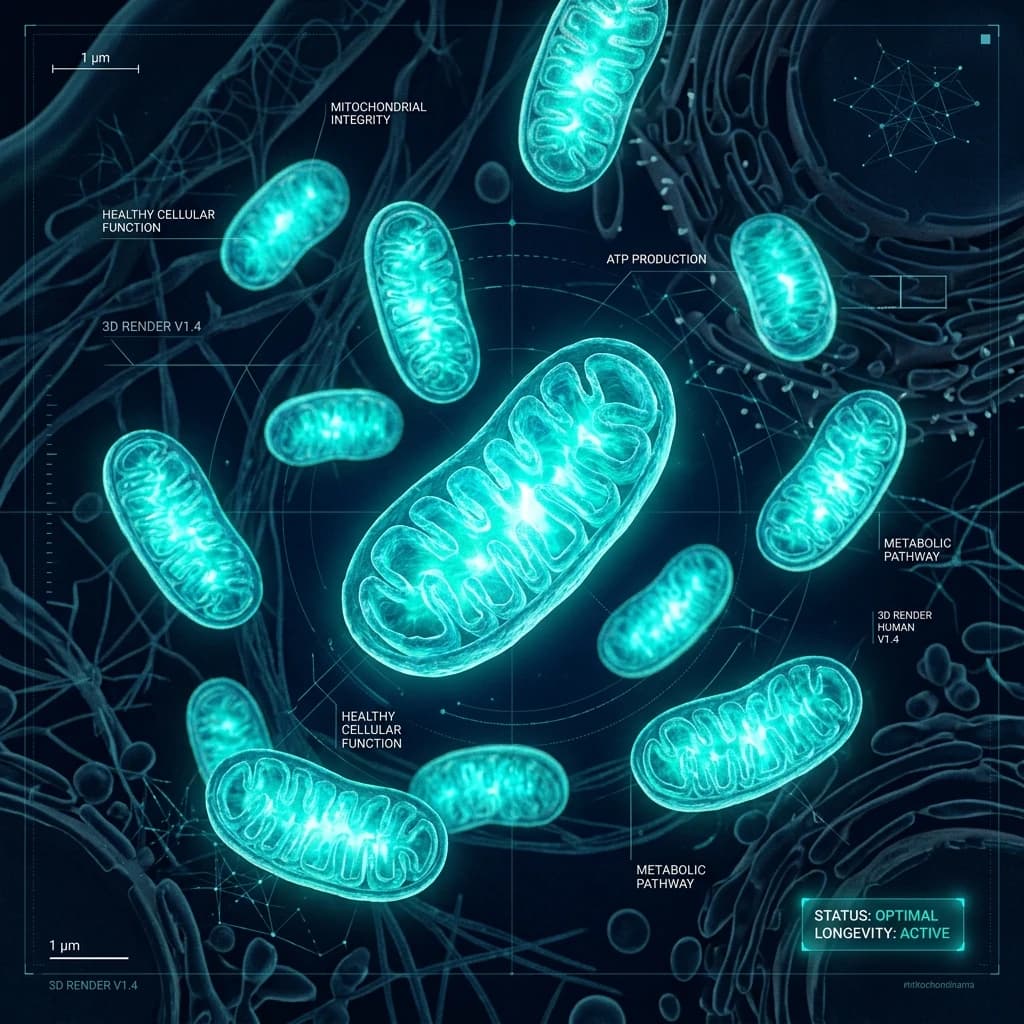
Electron Transport Chain Augmentation
Direct Electron Shuttling
Methylene blue acts as a unique redox agent within the mitochondrial electron transport chain. In its oxidized form, it accepts electrons from NADH; in its reduced form (leucomethylene blue), it donates electrons directly to cytochrome c — effectively creating a bypass that circumvents damaged Complex I through III.[2]
Researchers at the University of Texas at Austin found that this electron shuttling mechanism maintains ATP synthesis even when primary ETC complexes are inhibited, while simultaneously reducing reactive oxygen species (ROS) leakage — the primary driver of mitochondrial dysfunction and cellular aging.[5]
Neuro-Protective Signaling
By reducing ROS leakage from dysfunctional mitochondria, MB prevents the oxidative cascade that drives neurodegeneration.[4]
- ✓Nrf2 activation — upregulates antioxidant defense genes
- ✓NF-kB modulation — reduces neuroinflammatory signaling
- ✓BDNF upregulation — supports synaptic plasticity and neurogenesis
The Hormetic Dose Curve — And Who It Applies To
Methylene blue is routinely described as hormetic: low doses enhance cytochrome oxidase activity while higher doses inhibit it, producing an inverted-U dose-response.[5] The curve is real, but read the fine print on it. The inversion point comes from injected rodent studies (~50 mg/kg IP / ~60 mg/kg IV, rats — injected, not oral, not human) and is endpoint-dependent. It has never been demonstrated for oral dosing in humans, and no oral milligram figure on this site is derived from it.
No published randomized trial has tested chronic daily oral methylene blue in healthy adults for cognitive or mitochondrial endpoints. The 5-10 mg/day range is an extrapolation from single-dose human studies and from chronic dosing in patient populations, not a tested protocol.
- ✓Oral daily range (5–10 mg/day)Start at 5 mg in the morning with food, hold at least 7 days, then move to 10 mg/day and stay there. Flat milligrams, not milligrams per kilogram — every human oral study of methylene blue used a fixed dose. Labelled as an extrapolation, not a tested protocol. See our step-by-step dosing guide.
- ⚠Routine ceiling (20 mg/day)Editorial judgment, not a study finding — anchored to the servings actually sold in this category. No bodyweight or experience-level exception raises it.
- ⚠Where mg/kg figures come fromIntravenous clinical dosing (1–2 mg/kg IV is the antidote dose for methemoglobinemia) or rodent injection studies. Converting either into an oral supplement dose overstates it by an order of magnitude. For the endpoint-by-endpoint breakdown, see our safety page.
Cognitive & Neuroprotective Effects
Because methylene blue preferentially accumulates in mitochondria-dense neural tissue, it has an outsized effect on brain function. Researchers at the University of Texas Health Science Center found that low-dose MB enhances memory consolidation and provides neuroprotection through cytochrome oxidase upregulation.[1] For a detailed walkthrough of the fMRI findings and methodology, see our brain health research deep-dive.
Memory Consolidation
Researchers at the University of Texas at Austin demonstrated improved memory retrieval and sustained attention in a double-blind randomized controlled trial with 26 healthy participants.[1]
Neuroprotection Post-Injury
Researchers at the University of Texas Health Science Center at San Antonio found that MB reduced lesion volume and improved behavioral outcomes following mild traumatic brain injury in a controlled trial (n=48).[3]
Fear Extinction & Emotional Memory
Researchers at the University of Texas at Austin showed that low-dose MB improved fear extinction retention (n=42), suggesting enhanced consolidation of safety learning via cytochrome oxidase pathways.[5]
Mitochondrial Rescue
Researchers at the University of Texas Health Science Center demonstrated that MB can rescue cells from Complex I inhibition, maintaining mitochondrial membrane potential and ATP production through the alternative electron transfer pathway.[2]
Peer-Reviewed Clinical Evidence
Selected clinical and preclinical studies on methylene blue across neurological and metabolic domains. Evidence grades are editorial assessments. Browse the full clinical trial database for 12 registered studies with NCT identifiers.
| Study | Year | Design | N | Finding | p-Value |
|---|---|---|---|---|---|
| Rodriguez et al. | 2016 | RCT (double-blind), single 280 mg oral dose | 26 | A single 280 mg oral dose improved sustained attention and memory-retrieval accuracy on fMRI. Single-dose only — not a chronic daily-dosing trial | p < 0.05 |
| Wen et al. | 2011 | In vivo / in vitro | preclinical | MB rescued mitochondrial complex I inhibition and maintained ATP production via alternative electron transfer | p < 0.01 |
| Talley Watts et al. | 2014 | Controlled trial | 48 | Neuroprotection post-ischemia: reduced lesion volume and improved behavioral outcomes after mild traumatic brain injury | p < 0.01 |
| Tucker et al. | 2018 | Systematic review | multi-study | Comprehensive evidence for MB neuroprotection via mitochondrial function enhancement, ROS reduction, and autophagy modulation | -- |
| Gonzalez-Lima & Auchter | 2015 | Controlled trial | 42 | Low-dose MB improved fear extinction retention, suggesting enhanced memory consolidation via cytochrome oxidase upregulation | p < 0.05 |
Research Limitations
Evidence for oral methylene blue supplementation is primarily from small single-dose trials and animal models. No published randomized trial has tested chronic daily oral methylene blue in healthy adults for cognitive or mitochondrial endpoints. The 5-10 mg/day range is an extrapolation from single-dose human studies and from chronic dosing in patient populations, not a tested protocol. Many findings come from intravenous administration or in vitro studies, and may not directly translate to oral capsule delivery.
What the human oral record actually contains: roughly 72% absolute oral bioavailability in 16 healthy adults (Walter-Sack et al. 2009, doi 10.1007/s00228-008-0563-x); single high oral doses improving memory retrieval[1] and fear-extinction retention (Telch et al. 2014, PMID 25018057); 10 mg orally being well absorbed in healthy men (DiSanto & Wagner 1972); and chronic oral dosing tolerated over 24 weeks in elderly patients (Wischik et al. 2015, PMID 25550228). None of that is a chronic daily trial in healthy adults.
Milligram-per-kilogram results belong to the route they were measured on. Intravenous clinical doses and rodent injection doses must not be converted into an oral supplement dose — there is no human evidence that oral methylene blue should be scaled by bodyweight at all. We present this research for educational purposes and encourage readers to consult primary sources. For a transparent discussion of what the data supports and where gaps remain, read our balanced analysis of evidence and limitations.
Continue Your Research
References
- [1]Rodriguez P, Zhou W, Barrett DW, et al. (2016). Multimodal randomized functional MR imaging of the effects of methylene blue in the human brain. Radiology. PMC5084971
- [2]Wen Y, Li W, Poteet EC, et al. (2011). Alternative mitochondrial electron transfer as a novel strategy for neuroprotection. Journal of Biological Chemistry. PMC3091255
- [3]Talley Watts L, Long JA, Chemello J, et al. (2014). Methylene blue is neuroprotective against mild traumatic brain injury. Journal of Neurotrauma. PMC4043255
- [4]Tucker D, Lu Y, Zhang Q (2018). From mitochondrial function to neuroprotection — an emerging role for methylene blue. Molecular Neurobiology. PMC5826781
- [5]Gonzalez-Lima F, Auchter A (2015). Protection against neurodegeneration with low-dose methylene blue and near-infrared light. Frontiers in Cellular Neuroscience. PMC4428125
FDA Regulatory Notice
These statements have not been evaluated by the Food and Drug Administration. This product is not intended to diagnose, treat, cure, or prevent any disease. The information on this page is for educational purposes only and is not a substitute for professional medical advice. Consult your healthcare provider before starting any supplement protocol.
Free: The Biohacker's 90-Day MB Protocol
Science-backed dosing schedule + stacking guide
- Flat titration schedule with hold durations
- Serotonergic drug and G6PD safety screen
- Synergistic stacking protocols
- Biomarker tracking checklist
No spam. Unsubscribe anytime.